Here's exactly what you get as a Quant View™ subscriber.
The Daily Futures Market Intelligence Briefing.
Up to three focused single asset reports.
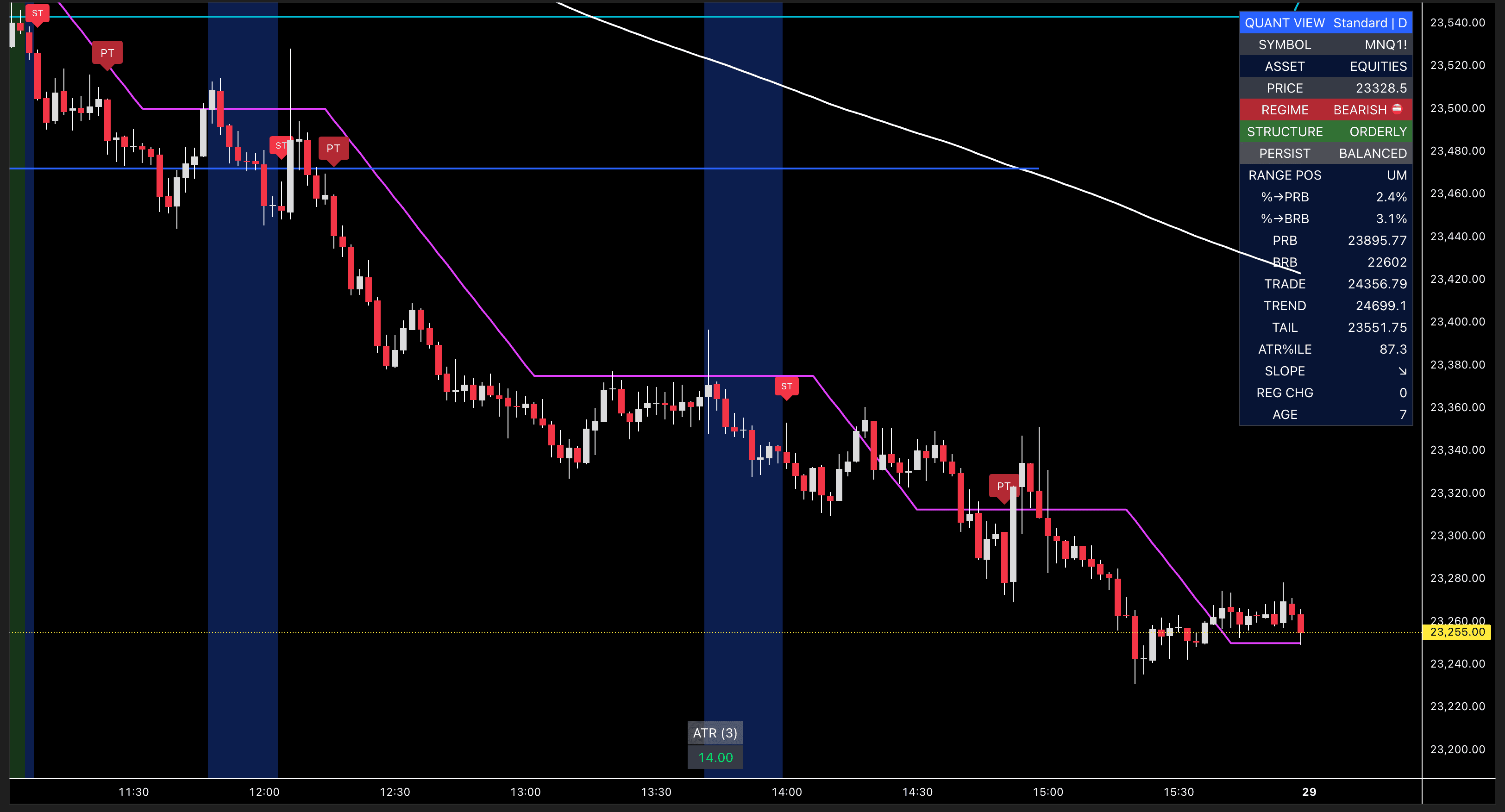
Two TradingView indicators to help guide your potential trades. You have access to the entire Quant View™ stack powered by PRISM™ (Price Regime Intelligence State Model). All within your portal every trading day before the open.
Three layers. One complete pre-trade picture.
This is what's delivered to your portal every trading day before the market opens:
LAYER 1 | The Daily Intelligence Brief
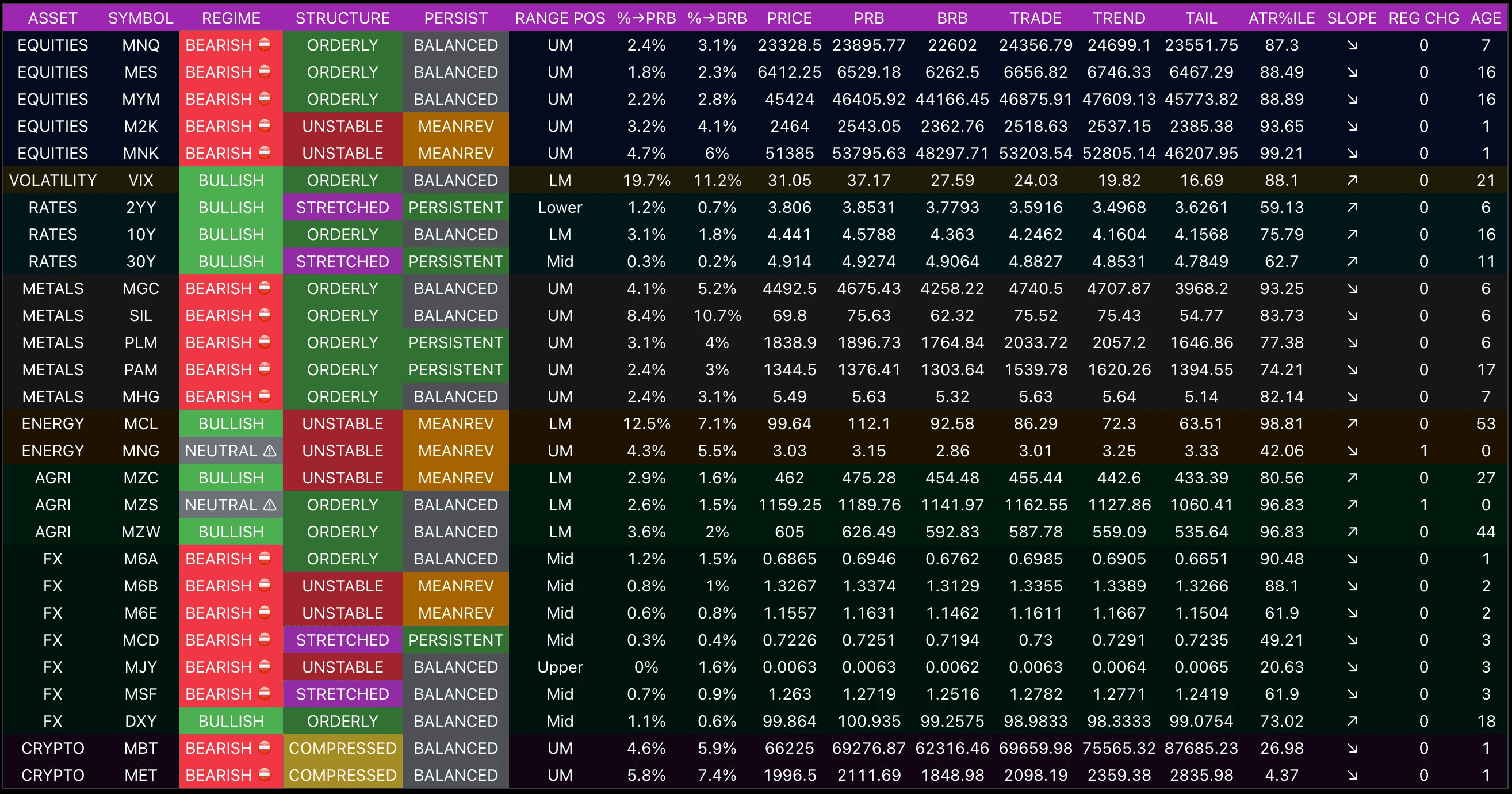
Every morning before the open, you receive a written briefing covering up to 30 futures markets — equity indexes, currencies, commodities. Each asset is classified: is this environment supportive, neutral, or hostile to participation today? The dashboard image is included so you can see the full market state at a glance. No guessing. No interpreting charts cold. A clear read, ready before the session starts.
LAYER 2 | Individual Asset Reports
Up to three specific markets get a focused deep-dive each day. This is where the macro picture connects to your actual trading session — potential opportunities, structural context, and exactly where your trade thesis would be wrong. If you trade the ES, NQ, or a specific currency futures contract, this is your daily playbook for that market.
LAYER 3 | TradingView Execution Indicators
Two proprietary TradingView indicators come with your subscription — QVFT (Quant View Futures Trader) and QVRB (Quant View Range Bands). These plot directly on your chart and translate the morning's intelligence into visual context at the execution level. What the briefing describes in words, the indicators show you in real time on price.
The brief tells you the condition. The asset report tells you where to focus. The indicators show you where you stand. That's a complete process — not just another tool.
What Quant View™ Is Not — and Why That Matters

Not a signal service
Not automated trading
Not a prediction engine
Not a replacement for skill
Not a shortcut to profits
What it does: it tells you the condition of the market before you risk anything — so that when you do trade, your decision is based on structure, not hope.
Good Execution. Bad Environment. Same Result.
A perfect entry in the wrong environment is still a bad trade. Market condition often determines the quality of the opportunity before the trade is ever placed. Professional longevity is not built on chasing better entries.
It is built on the discipline to adjust risk when conditions do not support execution.
Execution earns its place only when the environment supports it. When it does not, restraint is not a break
from the process. It is the process.
Built for Traders Who Think Before They Execute
● Traders who build a process and follow it — even when the market makes impulse feel justified
● Traders who believe in process over outcomes
● Traders who understand that how much you trade matters as much as how you trade
● Traders who define risk before the position is open — not after it starts moving against them
● Traders who measure themselves by the quality of their process — not the size of their last win
This is how disciplined capital behaves.
Access Quant View™ →


30 Years of Trading. One System. Built for the Independent Futures Trader.
© 2025 Copyright. All Rights Reserved